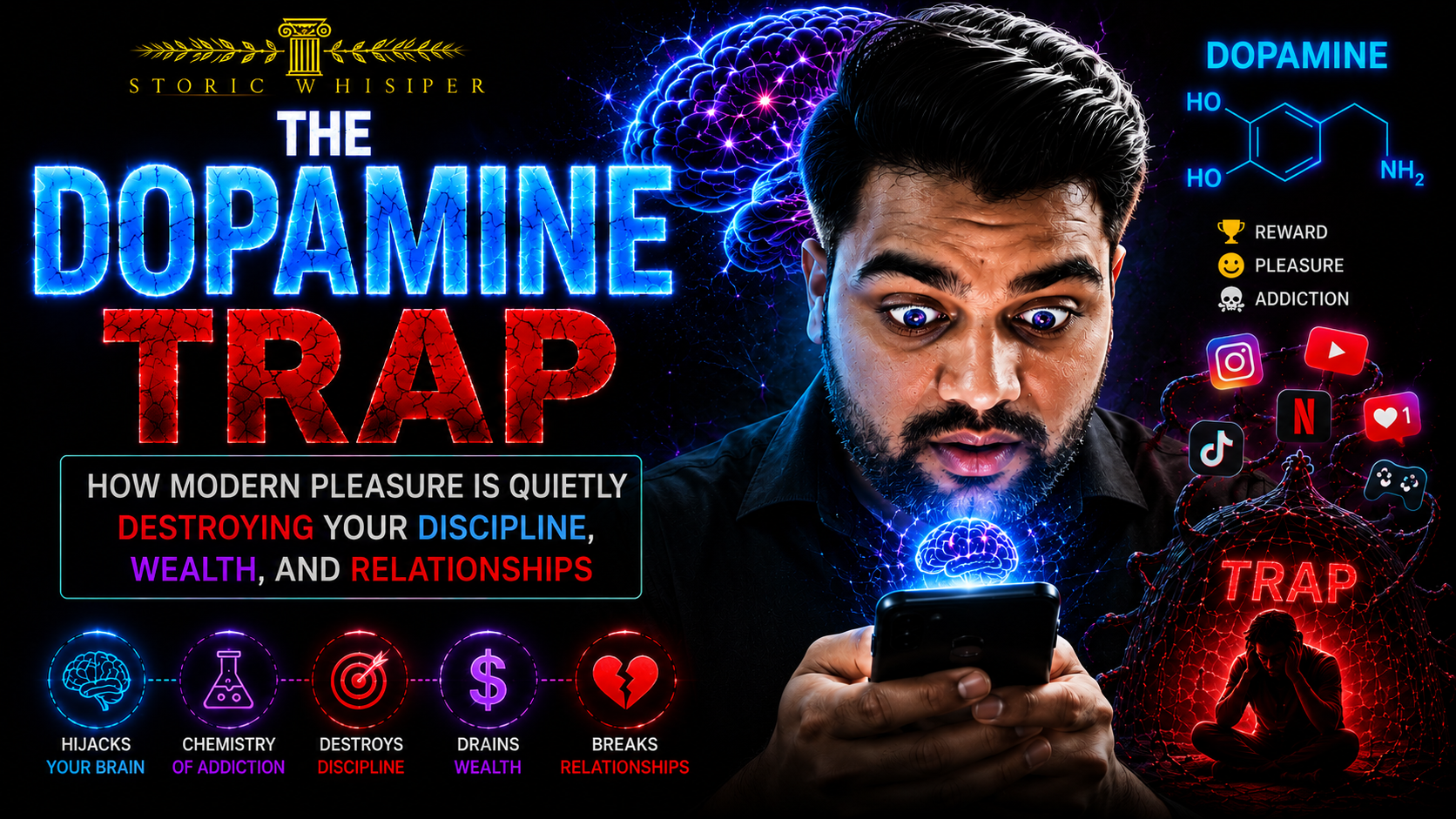
The Dopamine Trap: How Modern Pleasure Is Quietly Destroying Your Discipline, Wealth, and Relationships
Introduction: What Is Dopamine?
Before we can begin to deconstruct the invisible cage that confines the modern mind, we must first isolate the chemical master operating the gears from the shadows.
Dopamine is a fundamental neurotransmitter synthesized within the human brain—a biochemical messenger engineered to transmit high-velocity signals across neural networks.
Popular culture has committed a catastrophic error in branding dopamine as the "pleasure molecule." This is arguably the greatest illusion in modern behavioral psychology.
The Neuroscientific Reality: Dopamine does not register the sensation of pleasure. It manufactures the agony of anticipation and the relentless drive of desire.
Dopamine is your internal survival engine; it is the chemical fuel of motivation, explicitly designed to keep you hunting for a reward. The electric, restless excitement you experience right before you slide your thumb to scroll Instagram, or the frantic anticipation preceding the purchase of an expensive gadget—that is not happiness. That is a pure, unadulterated dopamine spike.
The modern world has systematically weaponized this evolutionary mechanism against us. Here is the exact blueprint of how it was achieved.
1. The Dopamine Myth: The Great Neurological Deception
We live in a hyper-consumerist culture that pathologically worships immediate gratification. Every incoming notification, every predictive algorithm, and every highly tailored advertisement is engineered to condition you into believing that the ultimate objective of human existence is constant, uninterrupted comfort.
Most individuals operate under the delusion that when they finally secure their targeted object—whether it is an exotic vehicle, a superficial validation metric on social media, or a highly engineered dose of hyper-palatable junk food—their brain rewards them with dopamine after the achievement.
This is fundamentally wrong.
[The Psychological Delusion]
Desire ──> Achievement ──> Lasting Pleasure (Myth)

[The Biological Reality]
Anticipation (Massive Dopamine Spike) ──> Achievement ──> Immediate Neurological Crash (The Void)
Dopamine does not deliver fulfillment; it enforces a state of perpetual seeking. Your dopamine levels reach their absolute zenith during the anticipation phase. The moment the reward is physically captured, the chemical baseline aggressively crashes.
This explains the universal psychological phenomenon where the intense thrill of opening an Amazon delivery completely evaporates within five minutes of unboxing. The objective has been materialized, the dopamine has dissolved, and your brain immediately commands you to launch the next hunt.
The global economy thrives exclusively on this error of human perception. If the masses realized that their desires are structurally incapable of being satisfied, consumerism would collapse overnight. Instead, the brain remains trapped in a feedback loop, whispering: "Just one more swipe, just one more purchase, and you will finally find peace." It is a multi-billion-dollar illusion that enriches corporations while leaving the human psyche entirely hollow.
2. What Dopamine Really Does: The Survival Engine
From the lens of evolutionary biology, dopamine was never designed to make you happy—it was engineered to keep you alive. Thousands of years ago, navigating ancestral landscapes, securing high-calorie nourishment, or locating a secure habitat were high-risk, energy-expensive endeavors. The brain required a ruthless motivational mechanism to force a primitive hominid out of the relative safety of a cave into a hostile environment.
Dopamine was that metabolic engine. The moment an apex predator anticipated finding a wild berry bush or tracking game, its dopamine levels spiked, granting it an immediate surge of physiological energy, hyper-focus, and aggressive drive. Once the nourishment was consumed, dopamine baseline plummeted to ensure the organism would remain hungry enough to initiate the search tomorrow.
[Anticipation / Trigger] ──> [Action / Search] ──> [Spike in Dopamine] ──> [Temporary Drop / Void] ──> [Repeat]
In the twenty-first century, our external environment has radically shifted, but our underlying biological operating system remains completely identical. We no longer have to fight predators for survival metrics; dopamine triggers are now delivered effortlessly to our fingertips.
When a massive surge of dopamine floods the system, it effectively hijacks the prefrontal cortex—the seat of executive function, logical evaluation, and long-term strategic decision-making. Your cognitive capacity becomes clouded. The future is instantly devalued, and your primal brain forces you to sprint toward immediate, low-effort relief. To systematically build back this compromised mental infrastructure, you must first master The Science of Self Transformation.
This constant state of seeking triggers an intense internal conflict known as the Dopamine vs. Serotonin balance. While contemporary self-help trends frequently conflate these two neurochemicals, their functional opposition dictates whether your default psychological state is one of profound internal sovereignty or chronic, exhausting anxiety. We will explore this specific, intricate chemical warfare in depth in a separate discussion, as its neurological implications are far more complex than most behavioral psychologists realize.
3. The Modern Pleasure Machine: Algorithmic Captivity
Humanity is currently navigating the most hyper-stimulating, synthetic environment ever constructed. The modern world is a frictionless, industrial-grade "Pleasure Machine," architected by elite data scientists, behavioral psychologists, and software engineers with a singular, predatory objective: to capture, monetize, and auction your attention span.
From the millisecond your eyes open to the moment you drift into fitful sleep, your consciousness is assaulted by artificial dopamine triggers. Complex predictive models understand your deep-seated psychological vulnerabilities better than you do.
- Algorithmic Feeding: Social architectures leverage your shifting moods, cognitive insecurities, and subliminal fears to stream content engineered to permanently displace your dopamine baseline.
- The Gamification of Existence: Financial trading platforms, fitness applications, and digital interfaces have systematically gamified reality. They wrap mundane actions in synthetic rewards, badge metrics, and phantom progress to keep you hooked.
The direct consequence of this unprecedented super-stimulation is the total destruction of our Boredom Threshold. Modern humans have lost the capacity to sit quietly in an empty room for five minutes without experiencing acute psychological restlessness. The brain has been conditioned to expect a high-velocity neurochemical "hit" around the clock.
This phenomenon is directly tied to the contemporary attention span crisis. The default mind can no longer process a single page of dense, academic text without experiencing an intense urge to seek a digital distraction. However, this crisis extends far beyond a simple inability to read long-form content; its corrosive impact on our long-term working memory and deep cognitive architecture demands a rigorous, isolated structural autopsy.
4. Why Your Brain Keeps Chasing More: Hedonic Adaptation
The moment you engage in a hyper-stimulating, high-dopamine activity, a powerful biological regulatory protocol is activated: Homeostasis. Your body is genetically programmed to maintain a strict internal neurochemical equilibrium at all costs.
Think of your brain as operating on a default dopamine baseline. When you experience a massive, unnatural dopamine spike—whether through a speculative financial win, an intense digital binge, or chemical stimulants—your neural pathways are flooded. The brain recognizes this sudden surge as highly toxic to its delicate cellular balance. To protect itself, it initiates an aggressive counter-measure: Down-regulation. It systematically blunts and closes off its own dopamine receptors.
What follows this defense mechanism is the most dangerous phase of the loop: The Dopamine Dip.
Dopamine Level
  ^
  |      /\  (High Stimulus)
  |     /  \
--|----/----\-------------------- [Normal Baseline]
  |  /        \      /
  |/           \____/  (The Painful Dip / Boredom)
  +-----------------------------------> Time
Because your receptors are now significantly less sensitive, your internal chemistry drops far below your normal baseline. You are plunged into an acute state of existential emptiness, profound boredom, and low-level cognitive anxiety. In clinical psychology, this survival mechanism is defined as Hedonic Adaptation, or the shifting of the Dopamine Baseline.
To escape this agonizing internal void, you instinctively return to the very activity that caused the spike. However, due to your down-regulated receptors, the exact same input no longer delivers the same psychological high. To match the original experience, you are forced to double the dosage, accelerate the scroll speed, or take higher risks.
The mechanism is far more complicated than most people realize. At this critical juncture, you are no longer pursuing an activity for pleasure; you are executing it simply to feel normal. You are no longer running toward joy—you are desperately running to outpace your own internal withdrawal.
5. The Hidden Cost of Instant Gratification
Instant Gratification—the extraction of high-value biological rewards without the historical prerequisite of physical or mental output—is the defining curse of modern civilization.
Throughout evolutionary history, a strict, unyielding Effort-to-Reward Ratio governed human survival. If an organism desired calories, it had to track prey or scale a tree. If it desired connection, it had to invest physical proximity and social risk.
The modern economy has completely severed this equation. We have entirely eliminated the effort while standardizing the immediate delivery of the reward.
[The Evolutionary Framework]
High Effort (Energy Investment) ──> Uncertain Reward (Balanced Dopamine)

[The Modern Architecture]
Zero Effort (Frictionless Swipe) ──> Guaranteed Instant Reward (Flooded System)
When the human brain learns it can bypass metabolic effort to receive massive neurochemical payoffs, the neural architecture governing persistence begins to rapidly atrophy. This is driven by the absolute laws of Neuroplasticity: the pathways you repeatedly fire become permanent superhighways; the pathways you neglect are systematically pruned away.
By indulging every micro-impulse instantly, the brain fundamentally unlearns the critical art of Delayed Gratification—the definitive ability to sacrifice short-term comfort in exchange for long-term existential sovereignty.
This decay manifests in three dominant behavioral addictions:
- Social Media Captivity: Where every individual swipe acts as a variable reward slot machine, feeding a constant need for social validation.
- Immersive Gaming Landscapes: Where minds extract a synthetic, artificial sense of masculine triumph and tribal victory without assuming any real-world accountability or physical risk.
- Hyper-Stimulated Consumption: Which systematically detaches the raw primal procreative drive from human intimacy, commitment, and vulnerability.
These specific behavioral addictions are often discussed superficially by self-help gurus, but their deeper structural damage to the human psyche is something we will deconstruct layer by layer in upcoming individual features. For now, you must accept a harsh truth: instant gratification is never free. The invoice is paid by the systematic liquidation of the three pillars of human excellence: your discipline, your wealth, and your relationships.
6. Dopamine and Discipline: The Death of Deep Work
True discipline is not an elusive character trait or a vague moral virtue. It is the calculated capacity to execute monotonous, high-friction, and cognitively demanding tasks with absolute consistency. Whether it is undergoing grueling physical training, mastering an abstract scientific discipline, or engineering a complex enterprise, every high-value human endeavor requires one variable: Delayed Reward. You must sweat today to harvest the asset years down the line.
The modern Dopamine Trap completely paralyzes this capability. When a brain has been deeply conditioned by instantaneous, frictionless inputs, it views any long-term project not as an opportunity, but as an existential punishment.
| Activity Type | Dopamine Response Velocity | Required Cognitive Effort | Long-Term Strategic Value || :--- | :--- | :--- | :--- |
| **Infinite Algorithmic Scrolling** | Instantaneous & Sky-High | Absolutely Zero | Strictly Zero / Negative |
| **Deep Strategic Work / Study** | Latent, Slow & Negligible | Intense Focus & Friction | Exponentially High |
The moment you sit down to execute deep, needle-moving work, your brain instantly performs a comparative economic analysis. It weighs the options: "On one side, I can receive an instantaneous hit of entertainment in ten seconds via this screen, and on the other, I have this dense text that will offer zero neurochemical feedback for the next four hours." Naturally, the primitive, un-evolved brain will choose the path of least resistance every single time.
Discipline is entirely an exercise in neurochemical management. If your internal dopamine receptors are permanently fried by synthetic stimulation, no amount of superficial motivational content, vision boards, or morning routines can save you. You will rely on willpower, your willpower will experience immediate exhaustion, and you will slide directly back into your automated baseline.
7. Dopamine and Wealth Creation: Capitalizing on Impulsivity
The creation of authentic, generational wealth is a profoundly boring, unglamorous, and patient process. It is a game played entirely through the mechanics of Compounding. The foundational law of compounding mandates a high degree of emotional regulation: you must actively deny yourself the urge to liquidate your capital today so that it can evolve into an independent economic empire tomorrow.
However, a dopamine-addicted brain is the mortal enemy of compound interest.
The global financial infrastructure has seamlessly integrated itself into the dopamine economy. Today, taking on high-interest consumer debt or executing speculative trades is as frictionless as hitting a like button.
- The Impulse Buying Feedback Loop: The exact moment an individual experiences a dip in self-esteem or an acute wave of boredom, the autopilot brain triggers a consumer impulse: "Execute a purchase." That new luxury garment or upgraded smartphone provides a fleeting, synthetic dopamine spike, while permanently crippling your net worth.
- Speculative Gambles and Market Dopamine: The modern generation is largely not investing; they are hunting for financial dopamine. The volatile, high-stakes adrenaline rush found in day trading options or chasing speculative cryptocurrency shifts mimics the exact neurological architecture of a high-stakes casino. This is not capital allocation; it is a desperate attempt to satisfy an internal chemical addiction on the altar of the open market.
Minds caught in this perpetual loop are structurally incapable of building deep wealth. They spend their entire lives sprinting on a corporate hamster wheel, trapped from paycheck to paycheck, because every ounce of their excess capital is instantly liquidated to quiet the screaming restlessness of their internal chemistry.
8. Dopamine and Relationships: The Erasure of Intimacy
The most tragic casualty of this neurochemical hijack is the slow, silent disintegration of profound human relationships. To architect a resilient, long-term partnership requires extreme patience, heavy emotional investments, the capacity to endure extended periods of domestic monotony, and unyielding commitment.
But dopamine demands absolute novelty. It actively loathes the familiar.
[Phase 1: Emergence]
New Relationship ──> Massive Dopamine Flood (Infatuation / New Energy)

[Phase 2: Stabilisation]
Time Passes ──> Familiarity Establishes ──> Natural Drop in Dopamine Baseline

[Phase 3: The Crossroad]
             ├─> Immature Choice ──> Abandon Connection ──> Hunt Novelty (Cycle Repeats)
             └─> Mature Choice   ──> Transition to Deep Bond (Oxytocin & Serotonin)
When you enter a new relationship, your brain is drenched in an intense chemical cocktail. This is the infatuation phase. Everything feels amplified, effortless, and cinematic. However, after months or years, as the partner becomes deeply integrated into your daily reality, the dopamine spikes naturally subside.
A neurologically mature individual recognizes that this drop is a healthy evolutionary transition. It is the cue to step away from the volatile chase of dopamine and sink into the stabilizing embrace of Oxytocin and Serotonin—the neurochemicals responsible for deep tribal bonding, absolute trust, and profound peace.
Conversely, a dopamine-addicted mind panics. It interprets the natural absence of an intense chemical spike as a definitive failure of the relationship, whispering: "The spark is dead. This person is no longer my soulmate."
Modern dating applications have accelerated this tragedy by transforming human beings into disposable digital commodities. The absolute second a minor friction or a wave of routine boredom emerges, the interface assures you that thousands of alternative options are waiting just one swipe away. We no longer repair connections; we simply replace them. By chasing endless novelty, modern humans have managed to become the most globally connected generation in history, yet profoundly the most isolated.
9. The First Signs of the Dopamine Trap: A Diagnostic Checklist
Millions of high-potential individuals are currently decaying inside this invisible matrix, entirely oblivious to their captivity. They internalize their stagnation as a moral failure, diagnosing themselves as fundamentally lazy or uninspired. In reality, their underlying neurochemical architecture has been systematically dismantled.
Review this diagnostic checklist to determine if your brain has been captured by the trap:
- The Content Parasite: You are fundamentally incapable of consuming a film, an educational lecture, or an elite masterclass without manually adjusting the speed to 1.5x or constantly skipping forward. The moment a slow, character-building scene manifests, your hand automatically reaches for your smartphone.
- The Phantom Notification: You experience frequent tactile hallucinations where you distinctly feel your phone vibrating in your pocket, only to pull it out and discover an empty lock screen. This is definitive empirical proof that your brain is pathologically starving for an external hit.
- Chronic Procrastination of Low-Dopamine Tasks: You routinely delay trivial yet critical administrative tasks (such as clearing bills, organizing data, or replying to essential emails) for weeks, simply because the execution delivers zero instant neurochemical payoffs.
- Anhedonia (The Death of Simple Joy): The default, low-stimulation joys of human existence—sitting in absolute silence with a close friend, observing an organic landscape, or consuming a clean, un-engineered meal—feel completely flat, flavorless, and unbearably boring.
If you identify with more than two of these metrics, your default dopamine baseline is severely compromised. Your choices are no longer directed by your conscious logic; your life is being actively steered by external algorithms and primitive biochemical urges.
10. Final Reflection: Reclaiming the Throne
The Dopamine Trap is the definitive psychological and existential crisis of the modern era. It cannot be resolved by consuming a pharmaceutical pill, nor can it be conquered by a desperate, short-lived burst of brute-force willpower. It is a profound structural crisis of human consciousness.
The contemporary self-help landscape attempts to prescribe superficial remedies like a "7-day Dopamine Detox" or "going off the grid." They sell the comforting fiction that turning off your smartphone for a week will permanently reset your neural pathways.
However, the reality of resetting your neural pathways is far more nuanced and less dramatic than what lifestyle vloggers lead you to believe. A brief, temporary detox cannot structurally repair a severely down-regulated receptor system if you immediately return to the exact same digital ecosystem without modifying your core operating rules.
The harsh truth is that you cannot flee from the modern world. You cannot abandon the global grid to live primitive lives in isolation. The existential challenge is not to demonize dopamine; the challenge is to reclaim absolute sovereignty over where, how, and why your dopamine is being expended.
Are you the absolute monarch of your consciousness, or are you merely a helpless slave to your neurochemical signals? The definitive answer is hidden in how you choose to navigate your very next boring afternoon—whether you instinctively reach for the screen, or choose to sit down and master the silence.
The choice belongs entirely to you.
Storic Whisper — Psychology without the noise.
This article is the first foundational piece in our multi-part series on Cognitive Hijacking. In our upcoming releases, we will unravel the mechanics of structural focus restoration and the hidden biochemistry of sustainable ambition.
➡️ Next Strategic Read
Ready to uncover why your brain aggressively resists upgrades? Advance directly to the second part of this empirical series: The Architecture of Control: Decoding the Hidden Forces of Psychological Stagnation.