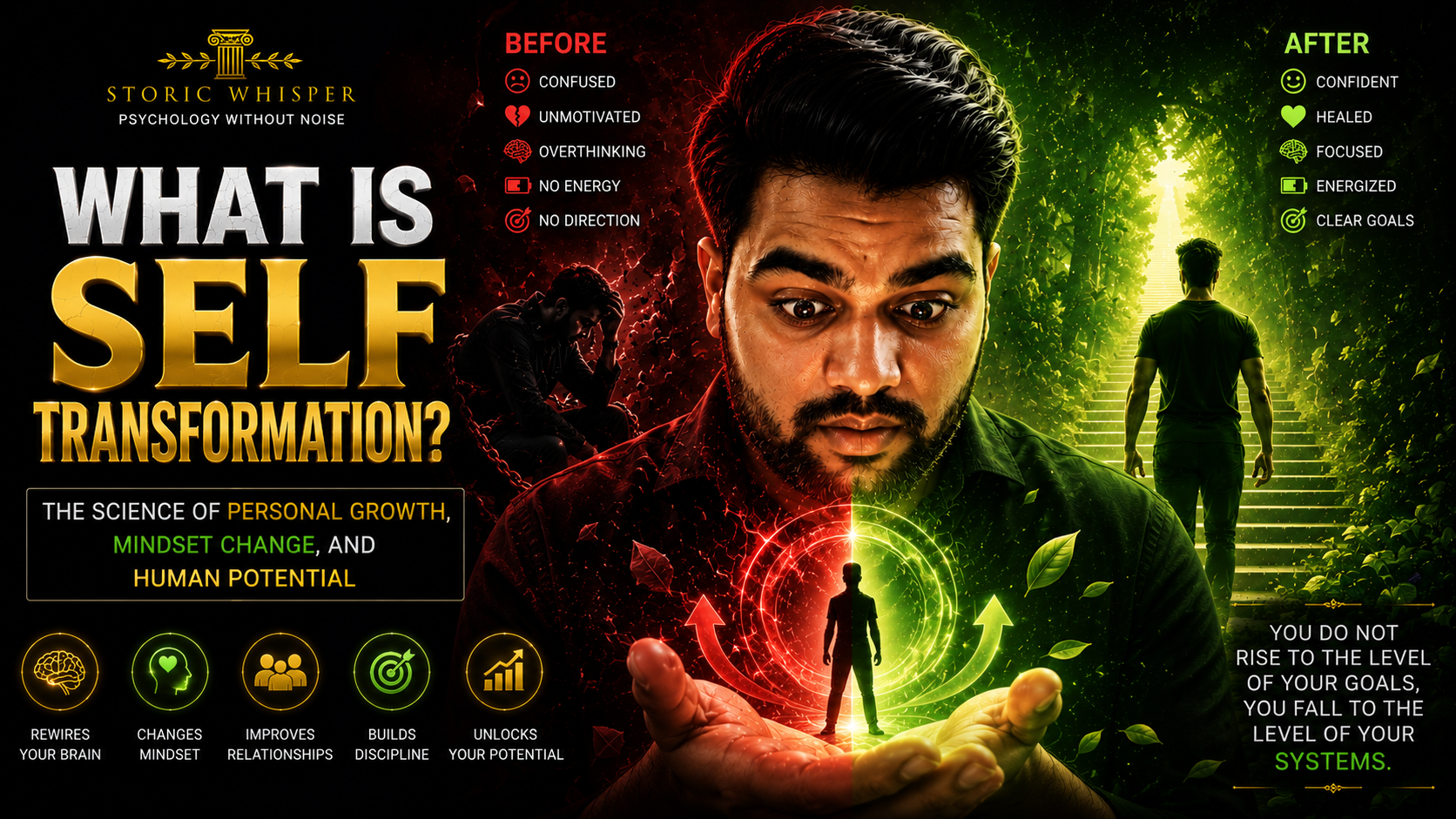
What Is Self Transformation? The Science of Personal Growth, Mindset Change, and Human Potential
Have you ever stared at a blank wall in the middle of the night, fueled by a sudden, electric surge of motivation, swearing to yourself that this time everything changes?
You promise to rewrite your routine, conquer new habits, and build the life you have talked about for years. You initiate the change. You cross off the first few days with pride. But then, the invisible gravity of your old life pulls you back. The momentum fades, the old patterns return, and by next week, you are standing exactly where you started—left with nothing but a toxic layer of silent guilt.
This loops back to a fundamental question: Can a human being truly change? And if the answer is yes, what does the actual process look like?
The answer is Self Transformation.
However, real self-transformation is not about chasing fleeting motivational highs, copying temporary lifestyle trends, or applying surface-level life hacks. It is a rigorous cognitive and biological engineering project. It is the precise process through which an individual systematically dismantles old mental structures to re-architect how they think, feel, decide, and exist at a foundational neural level.
What Is Self Transformation?
At its core, Self Transformation is the process of breaking free from deeply ingrained psychological, emotional, and behavioral loops to evolve a higher version of yourself. It is less about changing your external geography and entirely about altering your internal architecture.
• Buying a new car is a modification, not transformation.
• Changing your job or phone modifies your circumstances, not your being.
True transformation occurs only when your default perspective shifts. It happens when the lens through which you perceive reality is fundamentally rewired, and your daily execution detaches from the programming of your past personality.
In behavioral science, self-transformation is explicitly about a shift in your "Being" (who you are underneath), not just your "Doing" (what you perform on the surface).
The word identity captures this hidden mechanism beautifully. Derived from the Latin roots essentitas (beingness) and identidem (repeatedly), your identity is quite literally your repeated beingness. True transformation occurs only when you change what you repeat until it becomes who you are.
The Critical Importance of Self Transformation
Almost everyone alive wants to change their life, but 99% of people focus entirely on changing their conditions rather than changing themselves. This is where the path splits between permanent growth and predictable failure.
According to the groundbreaking framework of Nobel laureate Dr. Daniel Kahneman, 95% of our daily choices are manufactured entirely by System 1—the brain's unconscious, automatic autopilot. This system is highly optimized to conserve metabolic energy and aggressively resist change.
[External Stimulus] ──> [System 1 Autopilot (95%)] ──> Default Automated Reaction
                                  │
                       (Needs to be Hacked)
                                  ▼
[Self Transformation] ──> [Inner Sovereignty] ──> Conscious Strategic Response
Circumstances are rarely under our absolute control, but our cognitive frameworks, psychological boundaries, and strategic responses are. Self Transformation gives you the empirical tools to hack this autopilot system. This is precisely why the ancient Stoics and history's greatest leaders prioritized Inner Sovereignty over external conquest. They understood that if you do not govern your mind, your environment will govern you.
What Does Science Say? (The Neurological Reality)
For decades, human nature was thought to be fixed. Modern neuroscience has completely shattered this myth, proving that the human brain possesses a lifelong ability to structurally and functionally adapt. This phenomenon is known as Neuroplasticity.
Your brain is not a static stone; it is dynamic, living circuitry. A seminal study by Dr. Pippa Lally at University College London (UCL) revealed that anchoring a new behavioral pattern into the physical infrastructure of the brain takes an average of 66 days, varying from 18 to 254 days depending on the complexity of the behavior. The popular cultural belief that habits take only 21 days is a complete scientific myth.
Furthermore, neuroplasticity is strictly bidirectional:
- Positive Plasticity: Occurs when you consciously choose new neural inputs, deliberate focuses, and elevated states of execution.
- Negative Plasticity: Occurs when you passively repeat old anxieties, toxic habits, or self-sabotaging thought loops, making those negative pathways stronger and more automatic every day.
Because of this biological adaptability, a highly anxious individual can systematically build an unshakeable mindset, and a naturally unorganized mind can construct world-class discipline. Your brain is structurally designed to change; the only real question is whether you are intentionally directing that change or leaving it to default patterns.
How Self Transformation Impacts Life
1. Career and Elite Success
True professional leverage is rarely just a product of technical hard skills. Behavioral design proves that the vast majority of elite performance is dictated by cognitive architecture. Dr. Angela Duckworth’s historic research at West Point demonstrated that Grit (the combination of long-term passion and perseverance) is the single highest predictor of world-class success—massively outperforming traditional metrics like standard IQ, SAT scores, or baseline GPA. When your identity shifts, your strategic choices change. When your choices change, your real-world outcomes follow.
2. Relationships and Deep Human Connections
An internal shift fundamentally changes your entire social ecosystem. According to Albert Bandura’s foundational Self-Efficacy Theory (1977), when your internal self-perception shifts, your emotional intelligence expands exponentially. Instead of operating from a state of emotional reactivity—where you are constantly triggered by other people's actions—you transition into an objective, responsive state. You stop relying on external validation, allowing you to build relationships based on choice rather than codependency.
3. Unshakeable Emotional Strength
Life will never stop presenting unexpected chaos. However, deep personal transformation alters how your brain allocates its cognitive energy, protecting you from premature Ego Depletion (the exhaustion of mental willpower). Instead of reacting with a victim mentality or draining your energy fighting reality, transformation trains your mind to convert friction into strategic leverage.
4. Advanced Decision Making
Your current reality is simply the compound interest of your past decisions. Better choices create a better future, and better choices require an unclouded mental model. By systematically eliminating cognitive biases, emotional baggage, and defensive ego loops, self-transformation updates your brain's operating system, making your long-term decision-making incredibly sharp and clear.
Why Self Transformation Will Matter More in the Future
We are living through the most volatile, technology-driven era in human history. Industries are dissolving, artificial intelligence is rewriting professional demands overnight, and hard skills are becoming obsolete in matter of months.
In this hyper-accelerated future, the most valuable skill will not be a specific programming language or a fixed corporate methodology. The ultimate competitive advantage will be the capacity to constantly dismantle and reinvent yourself.
Recent 2025–2026 neuroscientific breakthroughs from Harvard and the University of Geneva regarding Dopamine Timing show that the brain’s Ventral Tegmental Area (VTA) maps out the exact temporal evolution of future rewards. If you cling to an outdated identity out of comfort, your brain's prediction models glitch, causing your motivational drive to completely collapse. Future sovereignty belongs exclusively to those who possess psychological fluidity—the rare courage to systematically destroy their old versions to let a more evolved self emerge.
The Empirical Benefits of Self Transformation
- Acute Self-Awareness: The ability to observe your unconscious triggers, biases, and behavior loops in real-time without emotional distortion.
- Strategic Decision Making: Transitioning from emotional reactivity to high-probability, data-informed long-term choices.
- Emotional Anchoring: Developing a profound baseline of internal stability that remains unbothered by external volatility.
- High-Leverage Relationships: The shift from needy, transaction-based validation to deep, authentic human alliances.
- Grounded Self-Efficacy: A deep internal confidence born from proven mastery experiences, not superficial affirmations.
- Hyper-Adaptability: The cognitive flexibility to pivot, unlearn, and master entirely new domains ahead of the global curve.
Conclusion
Self Transformation is not a casual 30-day challenge, nor is it a comforting motivational quote to read and forget. It is an ongoing, lifelong discipline of cognitive evolution. It is the journey of an individual who stops blaming external conditions and assumes absolute responsibility for rewriting the neural circuitry of their mind.
But this brings us to the edge of an unsettling psychological paradox.
If the human brain is genuinely neuroplastic... if our biology is literally engineered for profound adaptation... why do 99% of people who attempt to change stall out, give up, and quietly slide right back into their old self-sabotaging patterns?
Is it truly just a failure of willpower? Is it a lack of desire? Or is there a brilliant, terrifyingly silent psychological defense mechanism hidden deep within human biology that views transformation as a threat and actively breaks our progress from the shadows?
In our next deep-dive, we will step past the superficial self-help fluff to dissect the raw neural resistance holding you back:
👉 Why Most People Never Change Themselves | The Hidden Forces of Psychological Stagnation
➡️ Next Strategic Read
Ready to uncover why your brain resists upgrades? Advance directly to the second part of this empirical series: The Architecture of Control: Decoding the Hidden Forces of Psychological Stagnation.